
Midterms for Mock Con 2028
Though midterm elections are general elections, the implications they carry are significant for analyzing Democratic Party dynamics for the 2028 primary.
By Akash Abraham, ‘28, Political Chair
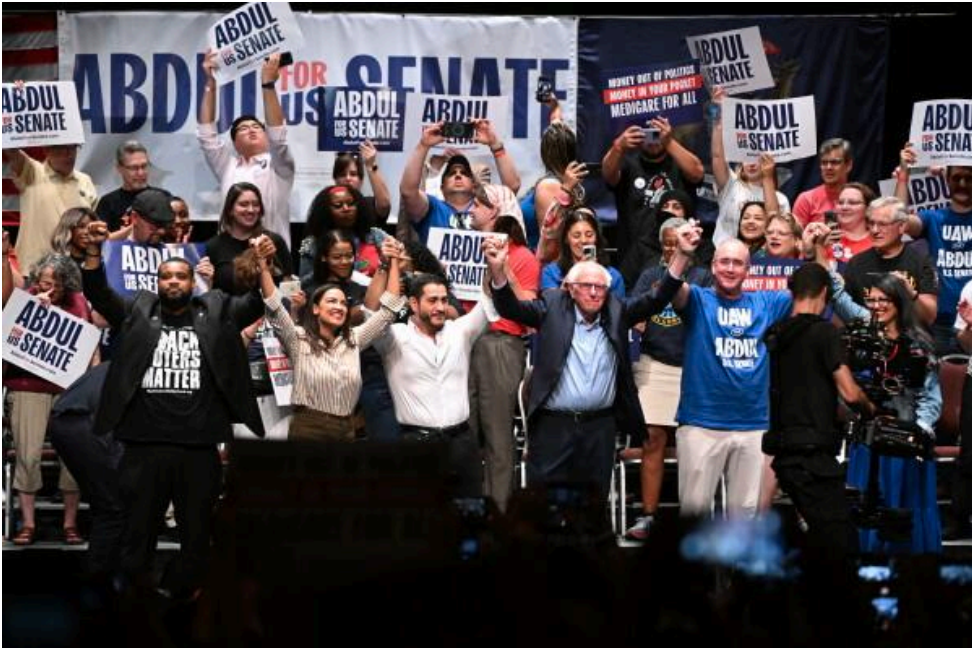
(Progressive candidate for Michigan Senate Dr. Abdul El-Sayed surrounded by progressive politicians Rep. Alexandria Ocasio-Cortez (left) and Sen. Bernie Sanders (right) | Source: Jose Juarez, AP Photo)
The upcoming United States midterm elections are supposed to be one of the most consequential elections in modern American history. A deeply unpopular President, war in the Middle East, an affordability crisis, and a state redistricting battle mean that the 2026 midterms carry significant implications. However, beyond the present issues facing the country, it is important to analyze what significance the elections carry for the 2028 Democratic Presidential Primary, which Washington and Lee Mock Convention 2028 is aiming to predict correctly.
The story has its origins in 2016, with the Democratic Party trying to find a new vision after two terms by President Barack Obama. In the 2016 Democratic Presidential Primary, two distinct groups in the Party emerged, led respectively by Hillary Clinton and Bernie Sanders that form the base for the primary ideological divide facing the Party today.
Clinton’s wing derived legitimacy from her vast political experience, ranging from First Lady to U.S. Senator to Secretary of State. The Clinton campaign, on the policy front, encompassed several significant reforms that varied across the political ideology spectrum, but the key theme was that the campaign supported “reform,” not “revolution.” Sanders’ campaign, on the other hand, embraced some of the more progressive policies in Clinton’s campaign, but called for much more drastic measures for a “political revolution” against the billionaire class.
Essentially, in 2016, the main ideological split within the Democratic Party was Hillary Clinton’s establishment and moderate-oriented campaign versus Bernie Sanders’ populist and progressive messaging. What resulted was a Democratic convention that was extremely competitive, with Clinton winning 2,807 delegates and Sanders winning 1,893. This political battle would set the foundation for the persistent ideological debates shaping Democratic Party dynamics for the next 10 years.
In 2020, the same battle pursued, except with former Vice President Joe Biden assuming the position as leader of the moderate, establishment-backed wing of the Democratic Party. In 2020, the Primaries were competitive in the early stages before Biden’s momentum surged after the monumental South Carolina primary.
Fast-forward to 2026, this battle within the Democratic Party has become much more prominent, in large part due to the question over how Democrats should respond from the political shake-up in Washington D.C. under the second Trump administration. The President has an all-time low approval rating according to a WSJ poll, with it actually being the lowest in the past few decades for an incumbent President heading into a midterm election. What this has prompted from the Democratic side is two broad categories of candidates over the future of America and how to best solve the country’s problems. These two categories are largely the same from 2016: moderate-establishment and progressive-populist.
For the spring and summer of 2026, the clash between these ideologies in the Democratic Party has defined the midterm primaries for Democrats. Some of the most defining primaries where this battle has been very prominent has been in the races for Michigan Senate, Wisconsin Governor, as well as several Congressional Districts in New York.
In Michigan, progressive and Bernie Sanders-backed candidate Dr. Abdul El-Sayed faced a tight contest with Establishment-backed Congresswoman Haley Stevens. In this race, El-Sayed defeated Stevens by 13,792 votes, which is an extremely tight race. The campaign strategy here is significant: El-Sayed campaigned on progressive issues such as Medicare for all, Money out of Politics, and criticizing support for Israel. He specifically called out Stevens for receiving large corporate PAC donations and support for Israel. Stevens’ campaign focused on pushback against the Republican administration and highlighting her electability and broader appeal to voters.
Similar races and election margins occurred in Wisconsin, New York, Colorado, and other places. In Wisconsin, moderate candidate David Crowley defeated progressive Francesca Hong by just about 4,000 votes. For New York, progressive Darializa Avila Chevalier won her primary incumbent, establishment-backed Congressman Adriano Espaillat by just over 2,500 votes. Across the country, the progressive versus moderate ideological battle within the Democratic Party has been evident. Moderates and establishment-backed candidates won handedly in certain races, narrowly in others, and the same was true for the progressive wing.
These trends for the midterms are extremely significant for Mock Convention as 2028 inches closer. Because of the Democratic Party’s proportional delegate allocation system, state-by-state Democratic preferences for either ideological camp might lead to an extremely competitive convention, making an electoral forecast considerably more difficult. For example, if the trends from Wisconsin hold in 2028, progressive Candidate A and moderate Candidate B could theoretically receive a nearly equal number of delegates from the 2028 Wisconsin Democratic Primary.
That is why the outcome of the general election for the 2026 midterms are so significant. If progressive candidates deliver wins, especially unexpected wins, that could reflect a future shift of the Democratic Party to unify around a more progressive platform. On the other hand, if progressives lose many races, then the Party can potentially try to re-orient itself around moremoderate policy issues. A related factor to account for is how the candidates supported by the leaders of each group fare in their races. If several of Rep. Alexandria Ocasio-Cortez’s endorsed candidates win, which could point to her growing influence within the Party, bolstering a potential 2028 Presidential Run.
All in all, a story that began in 2016 has now become front-and-center in 2026 for the Democratic Party. The upcoming midterm elections will be extremely significant for seeing how this battle plays out ahead of the 2028 Primary. The Mock Convention 2028 Political Department will be tracking these elections closely and incorporating the findings into our predictive strategy for 2028.