
Introducing the Mock Convention 2028 Political Model: HARRY
The key tool for Mock Convention predictive strategy has been its student-driven political model. The 2028 model has the potential to reshape Mock Convention’s election forecasting infrastructure.
By Akash Abraham, ‘28, Political Chair
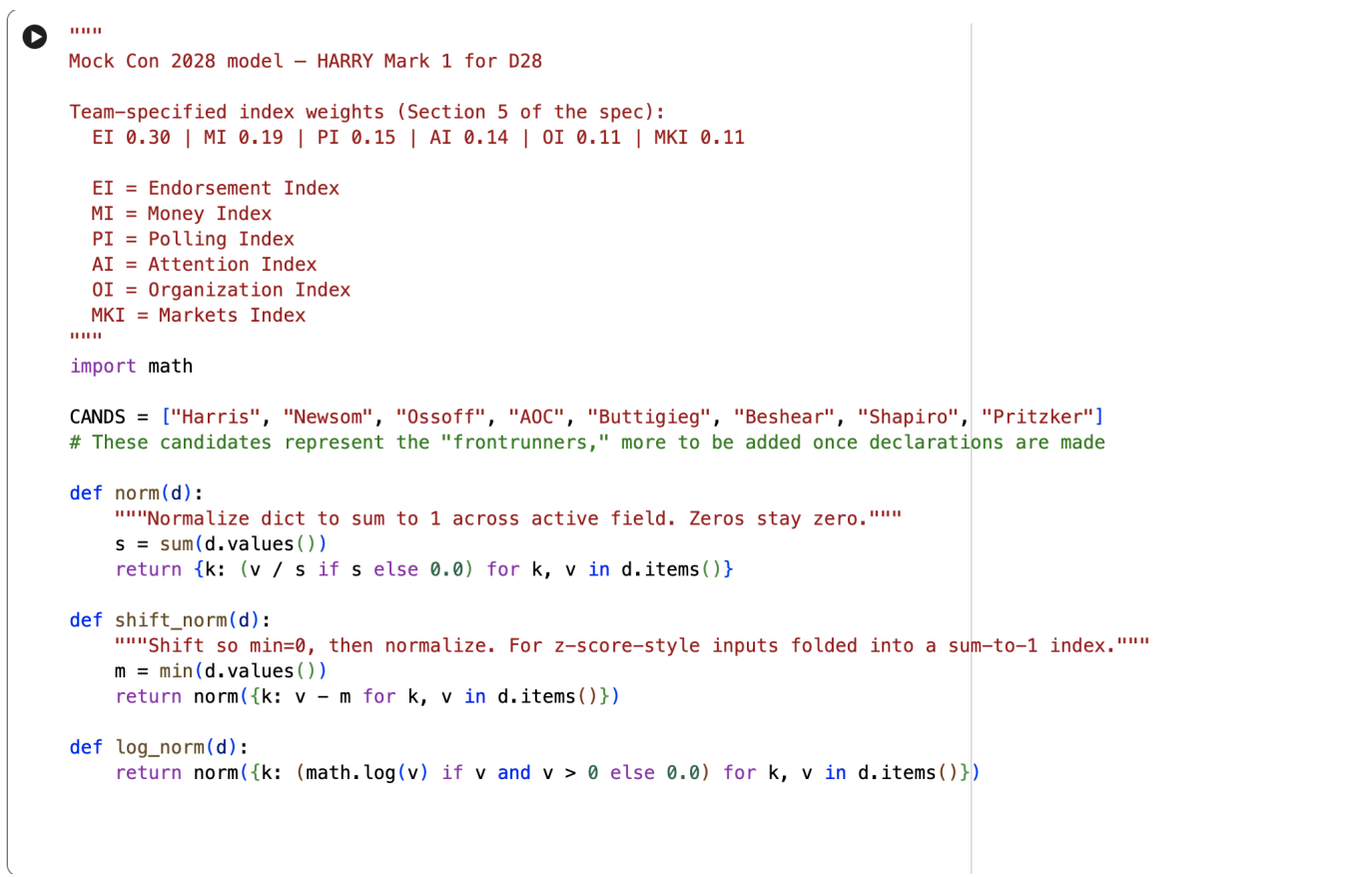
Snippet of code for the HARRY Mark 1 Model for Mock Convention 2028 | SOURCE: Author)
The Mock Convention 2028 Political Department is thrilled to unveil our predictive model for the 2028 Democratic Primary for President: HARRY. HARRY is not an acronym, it is simply the first name of Senator Harry Reid of Nevada (my home state), who served as Senate Majority Leader from 2007 to 2015 and names the Las Vegas International Airport.
HARRY Mark 1 was completed in September 2026, and it aims to forecast the probabilities of potential 2028 Democratic presidential candidates’ chance of winning the nomination. The model is designed to analyze a large, diverse pool of datasets based on the political parameters designed by the Mock Convention Political Department.
HARRY bases its probability model on 6 different political indices: Endorsements (30%), Money (19%), Polling (15%), Attention (14%), Organization (11%), and Betting Markets (11%). Within each of these indices are several sub-indexes pertaining to significant political factors that the Department wants to analyze, broken down into mathematical operations to give each candidate a number for each of the 6 indices.
To put it simply, the Department has chosen 6 different broad factors that we believe affect a candidate’s nomination chances. Within each of the 6 broad factors, are smaller sub-factors that we believe also have significant roles to play. For example, when it comes to polling, we have coded the Polling Index in such a way that not only does it account for a candidate’s polling numbers but it also accounts for the poll’s statistical robustness. On the Money Index, we not only count the total funds a candidate has raised, but we also base the index in part on the average amount of a donation, to account for a renewed focus of Democratic candidates on small-dollar donations.
What this ultimately leads to is a coding infrastructure that uses these political parameters and the data we give it to estimate probabilities for potential 2028 candidates. As of September 2026, HARRY is only in its first interface, with many more modifications to come as more data comes out and as people start declaring their intention to run for President in 2028.
Now, the key aspect of HARRY that makes it revolutionary for Mock Convention is that it is AI-powered, using some of the most cutting edge artificial intelligence technology available to humans. No other Mock Convention cycle has ever had access to this level of AI technology. While the political headwinds around AI continue to get stronger, there is great potential for integrating AI into Mock Convention.
I will start by saying that AI is not replacing the human, student-led nature of the Mock Convention prediction. To make this clear, an analogy is helpful.
Think of a pizza restaurant, where to make a pizza, the chefs must shape the dough, choose the ingredients, and then place it into the oven until it is cooked. Now imagine that the Mock Convention Political Department students are the pizza chefs and the AI is the oven. Students are deciding what exactly goes into the model, similar to how the pizza chefs decide exactly what the pizza looks like. All the AI does is “cook” the pizza; it simply gives us an output based on the inputs we give it. Every single value judgment or political analysis is done by students, the AI just enhances our data analytics and our coding capabilities.
Nowadays with so much more data around, having an AI-powered model that can synthesize this data using our parameters will revolutionize the prediction process for Mock Convention. Of course, the model’s output is not the end of the story. Our own intuition paired with the strategic insight we get from conversations will, as always, play a significant role in making the ultimate prediction. The AI-powered model is likewise, just another piece of the overall puzzle.
My hope for Mock Convention as it moves forward is that as AI advances and as students become more fluent in AI usage, the predictive modeling aspect of Mock Convention will only get better. Setting this infrastructure up for future generations to adapt and change is a top priority for the Mock Convention Political Department.